
In a world where nearly every song ever recorded is just a tap away, you might wonder why I spend hours scouring second-hand shops, purchasing physical albums, and digitising them meticulously. After all, I do have a subscription to Apple Music. But the truth is, while streaming offers convenience, it can’t replace the deeper connection I feel with owning my music: tangible, permanent, and personal.
The Tangible Experience of Ownership
I grew up with physical media: vinyl, CDs, tapes. Back then, the excitement of opening a new album, reading the liner notes, and getting to know the artwork was part of the musical experience. There’s something irreplaceable about holding a record or CD in your hands, knowing that the music is yours, not just rented for as long as your subscription lasts.
Even though I now digitise my physical collection to make it as accessible as any streaming service, I know that the music I’m listening to is something I’ve chosen to own. There’s a sense of permanence and security in knowing that no update, remix, or streaming rights dispute will alter my music collection. I believe, although I can’t prove it, that the audio quality from physical formats might be superior, too. There’s an inherent trust in knowing that what I’m listening to hasn’t been compressed or altered beyond recognition by the streaming platform’s algorithms.
Music Discovery: A Personal Journey
Sure, streaming services like Apple Music are good at suggesting new music based on your listening habits. But I can’t help but feel a little cynical about it. There’s something unsettling about a machine learning algorithm getting to know me so well that it can predict what I’ll like. And while the recommendations might often be spot on, I don’t like the idea of a service making decisions for me, even good ones. The spontaneity of discovery feels watered down when a machine is behind it.
Instead, I prefer to find music myself, in second-hand shops, online blogs, or through recommendations from friends. There’s a certain risk involved in making a purchase without having heard the album. Sometimes, the music won’t be great, but that’s part of the relationship I have with my collection. It’s an act of commitment, a bit like being faithful to the choices I’ve made. I take pride in knowing that, right or wrong, I chose it. And even if it’s not great, it’s mine.
The Tyranny of Streaming’s Endless Ocean
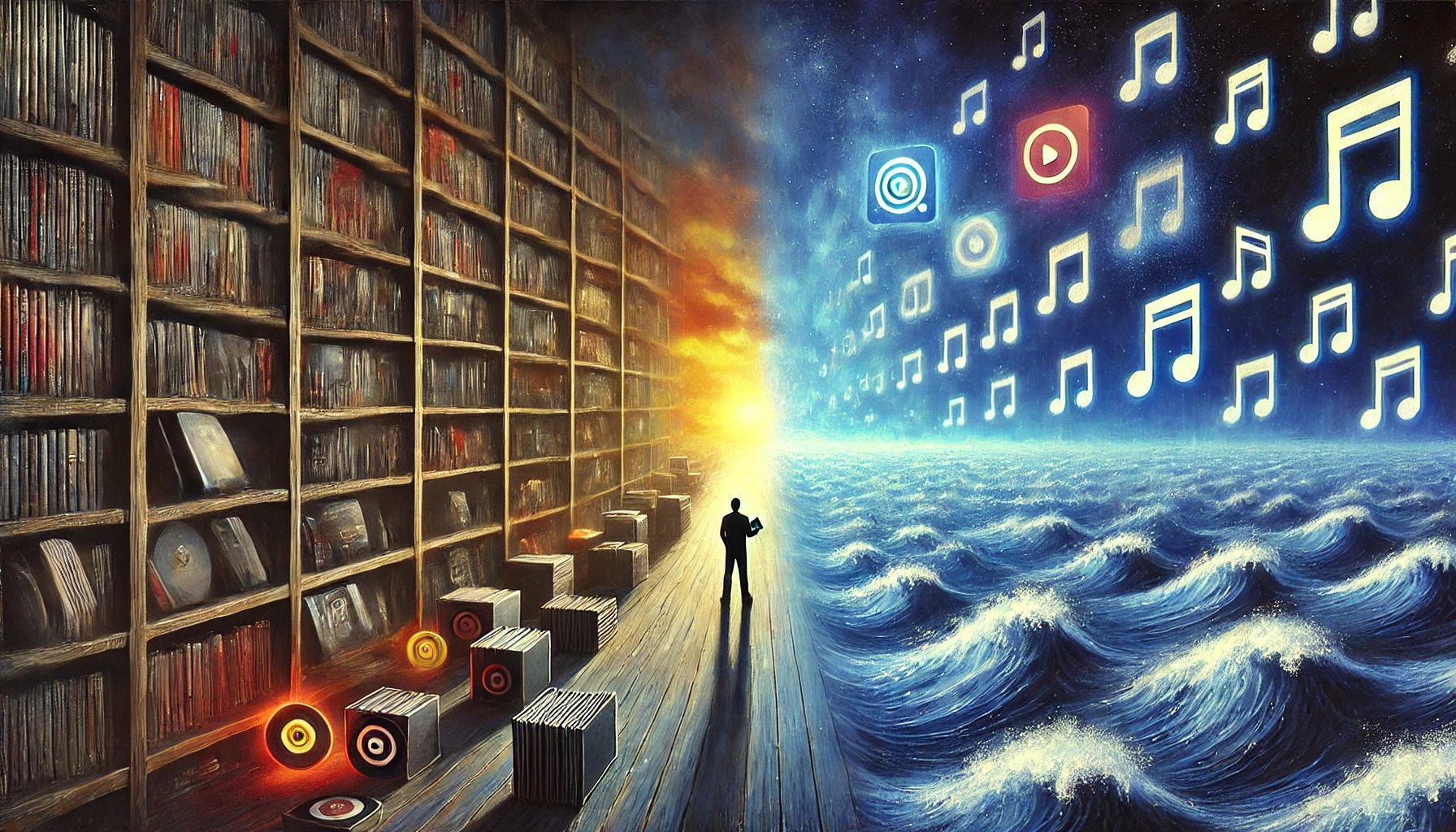
Streaming services offer an overwhelming ocean of choices, but the infinite nature of it can feel oppressive. If there’s always more to discover, how can you ever truly appreciate what you have? With physical media, there’s a psychological boundary to what you own. You can see it, shelve it, and know where your collection begins and ends. I’m a collector by nature, and having a limited, curated collection allows me to feel a connection to my music in a way that an endless, digital sea of tracks never could.
Streaming offers everything, but with it comes a paradox of meaningless abundance. When everything is available at your fingertips, how do you form any attachment? You might add countless albums to your digital librar, far more than you could ever realistically enjoy. Where’s the relationship in that? Where’s the commitment to sit with an album and really let it sink in?
Concerns About Permanence
Then there’s the issue of impermanence. With streaming, you never truly know how long an album or song will remain available. Artists change platforms, rights disputes lead to takedowns, and sometimes entire catalogues vanish. There’s also the looming spectre of remixes or revisions. As music is re-released, it may be remastered, edited, or even pulled from platforms altogether if it’s deemed problematic by modern standards. There’s something unnerving about the idea that music might be altered or censored without my control. Physical media, on the other hand, gives me the original work … unaltered, uncensored, and preserved as it was meant to be heard.
A Reflection of Who I Am
My physical collection is more than just music, it’s a reflection of who I am and the choices I’ve made over the years. I’ve invested in it, and I stand behind it, even if some of those choices haven’t aged well. There’s a personal history in that collection, a narrative of my musical evolution. Can the same be said for someone who relies entirely on streaming?
When you’re building a playlist on a streaming service, it’s easy to lose track of what you’ve added. Switch platforms, and you might lose everything. Even worse, what happens when a song or album is accidentally deleted? It’s a fragile relationship, one where the music you’ve curated might vanish at any time. For me, owning physical music that I’ve taken the time to digitise means my collection is always safe, accessible, and available on my terms.
The Value of Boundaries
In a world without boundaries, nothing feels personal anymore. Streaming’s endlessness comes at the cost of the intimacyyou have with your music. When I look at my physical collection, I see the trajectory of my life, the albums that shaped me at different times, the risks I took on new genres, the satisfaction of stumbling upon something special in a second-hand shop. It’s a curated experience, one I’ve built over years of commitment. That’s something no streaming service can replicate.